Wednesday, June 18, 2008

Bacon vs. Fake Bacon: Grudge Match!

The very first comment we received on our first post at Infusions of Grandeur was a request. That request has become both a running joke and a Holy Grail in the laboratory, something we've always wanted to do but never dared. The request was for vodka infused with the flavor of bacon.

Not long after we launched the site, a bacon vodka was in fact attempted by one of our mentors, the Vodka God. Unfortunately, his bacon infusion was roundly regarded as a failure, retaining an unpleasant fatty residue even after filtration. After the Vodka God's bust, bacon vodka was set the more firmly in our minds as a bad idea, though we occasionally considered trying it with artificial "bacon pieces" such as Bac-O's. (The Vodka God used pre-crumbled, reduced-fat bacon bits, but they were made of genuine bacon.) Last week, however, my esteemed colleague discovered a January post on the blog Brownie Points, which described another methodology for infusing vodka with real bacon and removing the fat afterwards.

We decided to peer-review the Brownie Points method, and to simultaneously create a fake "bacon" bits infusion for side-by-side comparison.


Part One: Brownie Points method

Brownie Points' author McAuliflower developed her bacon vodka by infusing vodka with cooked strips of bacon, unrefrigerated for three weeks. She then placed the infused vodka in the freezer, allowing the fats to solidify, then strained out the frozen fats using a coffee filter. (The Vodka God also kept his vodka in the freezer for serving purposes, but his vodka was only filtered pre-freezing, if we are not mistaken.) Of course, due to the chemical properties of ethyl alcohol, the vodka itself will not actually reach the freezing point in most household freezers.

Wayland began the experiment by frying some bacon in a science pan. We used three strips of bacon for the infusion; a fourth was reserved for immediate consumption.
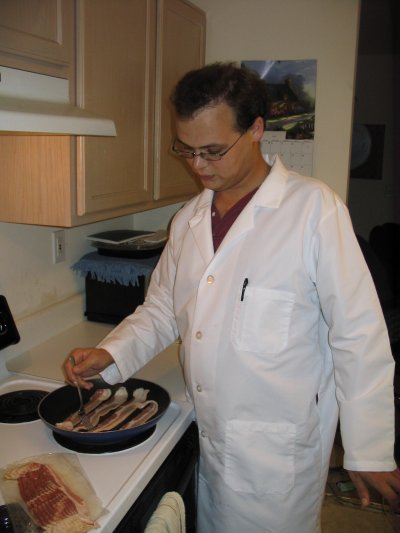


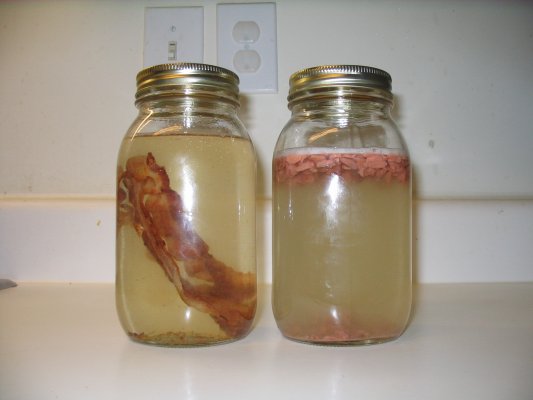
The bacon was cooked until crisp, and laid on paper towels to drain off as much grease as possible. We then sealed the bacon in a science jar with 750 mL of vodka, and placed it in a dark cupboard.


Part Two: Artificial bacon bits method

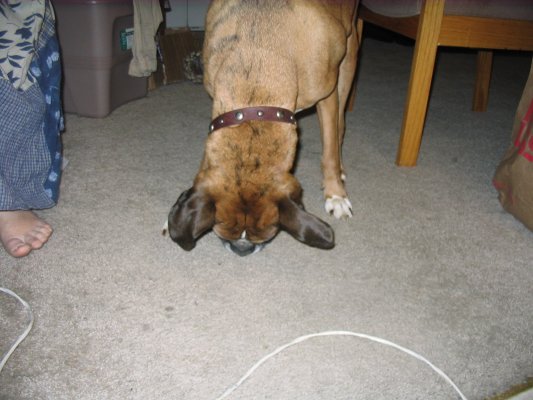
For the second test batch, we used 1/2 of a cup of McCormick Bac'n Pieces. As we discovered, dogs really don't know it's not bacon.


The bacon bits contain no cholesterol, but they do have 1.5 grams of fat per 7 gram serving. This means that they are roughly 21% fat, so our attempt to eliminate fatty residue may well backfire on us. For the record, the ingredients listed on the bacon bits' label are as follows: textured soy flour, partially hydrogenated soybean oil, salt, corn starch, natural and artificial flavors, caramel color, hydrolyzed soy protein, corn gluten, wheat protein, FD&C red 3, and autolyzed yeast.

We combined half a cup of bacon bits with 750 mL of vodka and shelved it. For control purposes, we will subject this batch to the same freezing process as the other one.

We'll see how this turns out in three weeks!
Monday, June 16, 2008

When I say bounce, you say, how high?

It's Mixology Monday again, and this time we decided to participate on purpose. The theme of this month's MxMo is Bourbon, so we are again straying from our vodka background, but again sticking with our core competency, infusion. Today's experiment is a drink which, though less common today, is steeped in tradition: the Cherry Bounce. (To see the other MxMo Bourbon participants, you can visit Scofflaw's Den, this month's host, who will post the wrap-up soon.)

While researching the Cherry Bounce, we discovered an interesting historical tidbit about our own home territory, Raleigh, North Carolina. We had long known that Raleigh, built specifically to be the state capital, was decreed to be established within ten miles of Isaac Hunter's Tavern, a favorite dive of the Constitutional Convention. What we did not know is that Joel Lane, the Revolutionary colonel who sold the plot of land where the capitol now rests, was rumored to have plied the Convention members with a libation of his own, the Cherry Bounce. Thus, this concoction may have been an integral part of the city's origin.

The Cherry Bounce consists of bourbon infused with cherries and sugar. We used brown sugar, hypothesising that the molasses in the sugar would match well with the smokiness of the whiskey.


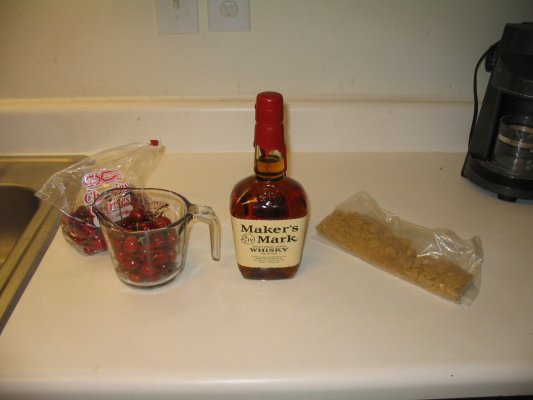
We began with the following ingredients:

2 cups cherries
1 cup brown sugar
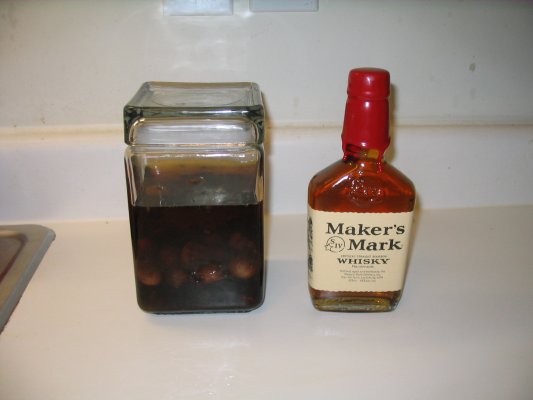
750 mL Maker's Mark Bourbon

Oh, how I long for the day when our nation switches to metric, so we can stop mixing-and-matching in the lab.

The various recipes we found in our research advocated a wide range of mashifying for the cherries, from well-ground to whole. (We found the use of whole cherries hard to believe, after our blueberry vodka experiment.) We decided to pick the middle road, and break them up a decent amount with a blunt instrument without entirely pulverizing them.

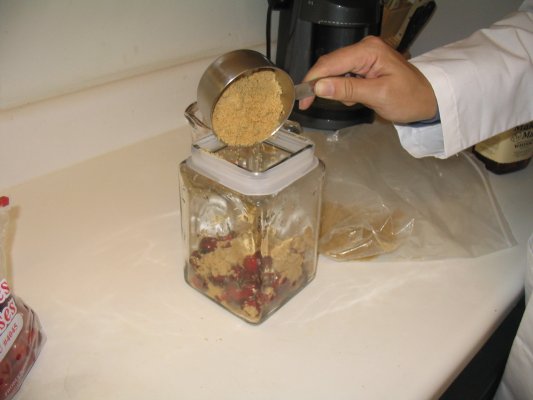
First, we dumped the cherries (seeds, stems and all) and sugar into a science jar. We used our old (and admittedly not airtight) jars, since the canning jars we've been using are not large enough for this experiment.


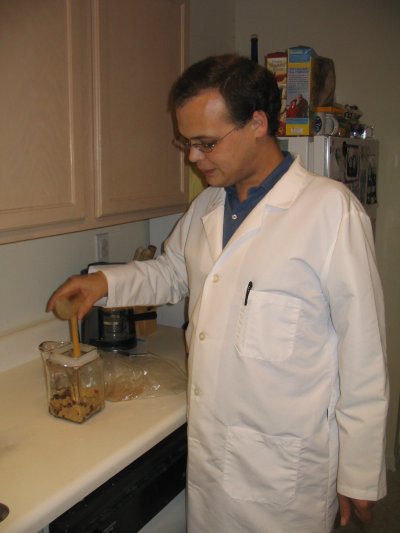
Then, Wayland began to mash the cherries with the handle of a science hammer, allowing the cherry bits and the sugar to mix well together.


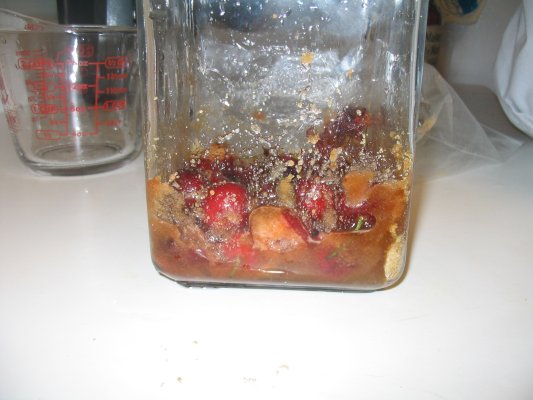
After a while, the sugar and cherry juices turned to a thick syrup with large chunks.


We then introduced the bourbon, and put it on a shelf in the science pantry.


Most of our research indicated that the Cherry Bounce should infuse for three weeks. Due to the time constraints of the MxMo, we were allowed two and a half weeks before our official tasting. At this point, the bourbon had taken on a much darker hue than when it started.


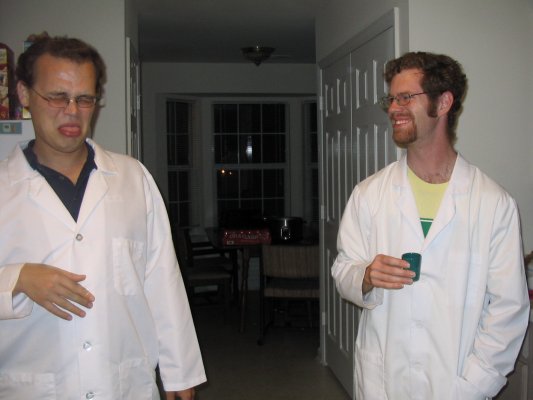
As we are not whiskey drinkers generally, we decided to begin with a drink of plain Maker's Mark for control purposes. Alas, we are not very good at faking snobbishness, so we can't provide much description of the flavor qualities. "It was a little rough, though much smoother than most other whiskeys I've tasted," I wrote. "It would take some getting used to, but the flavor was pretty decent once the burn passed."

Wayland was unimpressed with the control bourbon. "It was kind of bland on the front end, and the back end was just not appealing to me. I don't know exactly how to describe it, but it's definitely not my cup of tea."


We then proceeded to the Cherry Bounce. We poured a dose of the concoction through cheesecloth to remove the particulates, chilled and sampled it.

"That was neither as sweet nor as cherry as I was expecting," Wayland wrote. "It was a bit sweeter and smoother than the baseline; however, it was only a mild change. Although that change did make it go down much easier."

My thoughts were similar. "This is a little sweeter, due to the sugar, but I didn't detect much cherry flavor. I think this needs more time, and possibly more cherries."

Of course, like most of our contemporaries, we've never tasted a traditional Cherry Bounce before, so we're not entirely sure what the proper flavor should be. We are, of course, used to infusing vodka, which accepts flavor much more easily due to its own lack thereof. However, we did expect more than a very faint hint of something potentially cherry-like. There is also the fact that we had to cut the experiment a bit short. We were hoping to have the final results of this experiment ready for Mixology Monday, but we will keep the infusion going a little longer, probably with a few more cherries, and update again when we reach a verdict.

In a few days, we will present the beginning of the first true vodka infusion experiment we've started since the relaunch. We really have a good feeling about this one, so stay tuned!

Wednesday, May 28, 2008

You put the pineapple in the coconut and infuse it all up...

Two weeks seems about right for pineapple infusions. So after two weeks, we once again ventured into the lab to pit our wills against our own creation and see if we could come out still upright, with taste buds intact. We started off by pouring two baseline shots of straight Bacardi Coco for control purposes. Now personally, I've been a fan of this rum for a while. It's one of the few coconut rums out there that still weighs in at a hefty 80 proof. (Unlike the more popular Malibu Coco, which comes in at a wimpy 41 proof. That's not a rum, that's a cordial.) I don't know if I've ever actually drank it straight before, but we must do what we must do in the name of science. So we downed the shots and wrote our reactions.
Me: "That's coconut alright. It has a slight burn on the back end, but smooth otherwise. It leaves a slightly unpleasant overpowering coconut taste on the back end, however."

Brendan: "That's pretty smooth, though there is some burn. It tastes like coconut, that's for sure. I can't comment on the rum itself, since I'm not that familiar with light rum."

So, with our palates accustomed to the "before" phase of our experiment with very similar reactions, we ventured forth to taste the "after."

Me: "That's good. The pineapple leaves a sweetness that is absent from the plain Coco. Although, the coconut flavor is all that's left by the back end. This is quality; I wouldn't be opposed to leaving it longer and seeing if we could get more pineapple from it, but I'd be content to take it as it is too."

Brendan: "The pineapple flavor is just strong enough to balance with the coconut. It tips somewhat in the pineapple's favor at first, but slides back towards coconut in the end. Most of the alcohol burn is actually cut out on this one. I think it's a success, though I'm afraid most cocktails we us this in would be redundant."

After a brief discussion, we decided to declare this one a success, bottled it, and put it on the shelf. Since then, we've actually tried a couple pretty decent cocktails with the rum; but as of yet, those cocktails have yet to be examined with our normal scientific rigor, so the readers will just have to wait to see what I've come up with. We've started the Third Age of IoG with a success and the closing up of loops. Hopefully, that bodes well for the current incarnation.

Coming up next - Snickers Infused Vodka!

Monday, May 26, 2008

It is a scientific fact that pears are funny-looking.

As promised, today we are presenting the results of the remaining cliffhanger experiment from before our hiatus: pear infused vodka. This experiment used the same methodology we developed through trial and error for our apple vodka: we sliced a pear into wedges, infused it for five days, then replaced it with a fresh pear, repeating this twice for a total 15-day infusion.

The vodka came out with a deeper, darker color than our apple vodka. "There is definitely a pear-ish flavor to this," Wayland commented. "It's smooth and quite sweet, with no hint of burn. Not quite as much of a pear flavor as I'd like, but I'll call this a success."

My thoughts were similar. "This is very sweet, and has a very pear flavor, though it doesn't quite become distinct until the back end. The sweetness is almost too much, but not quite; it's just on the end of quite tasty. I like it."

Unlike the apple vodka developed in the Big Experiment, we did not use a spoonful of sugar at the onset of this infusion. It appears that this is a good thing, since it drew plenty of sweetness from the pears themselves. It is possible that a bit more time could have given this vodka a more comprehensive pear flavor, but we're pleased with what we came up with.

Thursday, May 22, 2008

A spicy blast from the past

After a long process of excavating the various piles of documents, scribblings, and gadgetry that adorn my science desk, I was able to recover the fossilized remains of the tasting notes we made in January, just before the blog went inactive. These notes reveal the results of the last few infusions of that period, which were completed but the results never posted. (Of course, we could have simply tasted them again - which we still did, so that I could write this with a fresh memory. But discovering the original notes for the write-up lends an element of closure to the experiments themselves.)

On Monday, we will present the results of the pear infused vodka experiment. Today's post concerns the other* "lost" experiment, our peppercorn vodka.

To recap the starting post of this experiment, we created our peppercorn vodka by pouring a shallow layer of whole peppercorns into a science jar, before pouring 750 mL of vodka over them. We sampled the vodka after two days, and decided it wasn't quite done and gave it another.

After three days, we conducted our official tasting. Wayland's reaction was quite clear. "That's got a burn! And not a vodka burn. That's very much a black pepper flavor. I think it's dead on, and very much a success."

"This vodka has a strong spice, but also an odd, slight sweetness," I wrote. "The pepper flavor comes through well, despite various warnings that the corns must be cracked, or that the flavor will be slimy."

It is possible that the vodka could have been made even better if we had in fact cracked the peppercorns before infusing them. It is also possible that this would have made the flavor too strong. Perhaps one day we will do a side-by-side test to see which method is preferable, but for now, we are quite satisfied by the product that resulted.

*Not counting the kiwifruit vodka experiment, which remains unresolved from our first hiatus. We hope to soon bring this one to a close also; I actually found some of the notes for this experiment as well, but I don't remember what happened to the vodka itself.

Monday, May 12, 2008

Yes, we.... planned this all along.

After returning from hiatus with a new pineapple-infused coconut rum experiment, we discovered that today happens to be Mixology Monday, and that today's MxMo subject is coincidentally rum.

So, we're retroactively declaring this morning's post to be our contribution to this time-honored tradition. You can watch for other MxMo participants at this month's host, Trader Tiki's.

It was the Dawn of the Third Age...

Ten years after the Earth-Minba--oops, wrong intro. Welcome, readers new and old alike, to the third debut of Infusions of Grandeur. Your hosts, the Mad Scienticians Brendan (that's me) and Wayland, are returning to the laboratory to concoct new vodka infusions, experiment with new cocktails, and uncover new scientific discoveries in the field of Alconomics.

In the near future, we will be posting results to the pear and peppercorn vodka experiments, which were left open when we went on hiatus. (Despite the drop-off in posting, we did remember to finish the experiments this time.)

For today, however, we wanted to do something a little different. The last time we came back from a long break, we attempted an experiment which delved into liquors other than vodka for the first time. We have always used, as a base for our infusions, the cheapest vodka we could find, which we filter through a Brita or Pur filter five times to remove the impurities; we tested to see if other liquors could be similarly improved. (It was a horrible failure.) This time, we've decided again to experiment with something other than vodka, but we're bringing it back to our core strength: infusions. To be specific, we've decided to infuse coconut rum with pineapple.

Okay, sure, so we're flavoring an already-flavored rum. But these are two flavors that we know work well together. We could, of course, infuse plain rum with both coconut and pineapple, but we didn't want to do this without tweaking our coconut infusion methodology first. When we made coconut-infused vodka, it took forever, and though good, it didn't quite match up with our hopes for it. So, this is what we settled on.


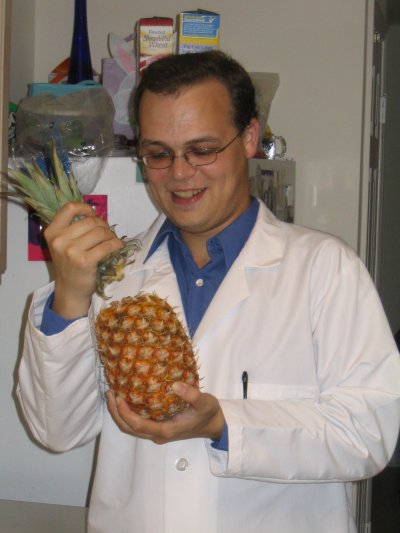
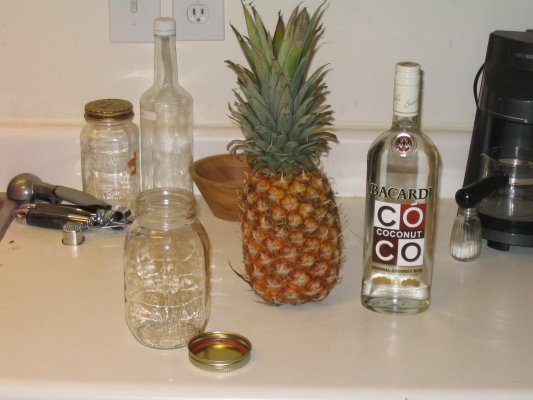
We began with a bottle of mid-grade liquor, Bacardi Coco, and a pineapple. Wayland set the experiment in motion by brutally executing the pineapple with a quick beheading.


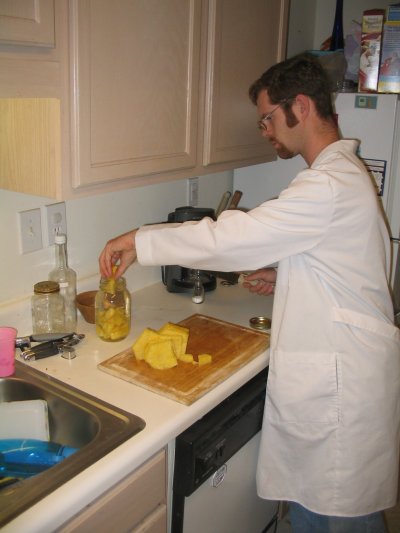
I cut the skin off of the pineapple, sliced it and cut the slices into chunks. We poured the rum into a science jar and dunked in as many pineapple chunks as we could squeeze in. The rest was stored in our science fridge for breakfasting purposes.


Our pineapple vodka took just over two weeks to infuse; we are assuming this will take a similar amount of time. We will update on this experiment then; in the meantime, stay tuned for long-overdue results and some other new stuff.