Tuesday, August 12, 2008

Neil Gaiman cameo! Also, The Ferrett drinks something weird.

Last year, we mailed a bunch of samples of infused vodkae to our friend, the reknowned blogger and webcomic author The Ferrett, who shared it with some friends and wrote a review for our site. (You can read his original three-part review here, here and here.) Recently, we sent another batch of samples to him in San Diego, where he's attending the Clarion Science Fiction and Fantasy Writer's Workshop.

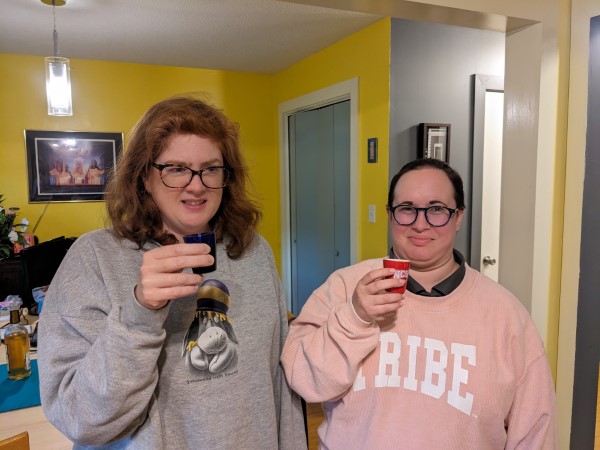
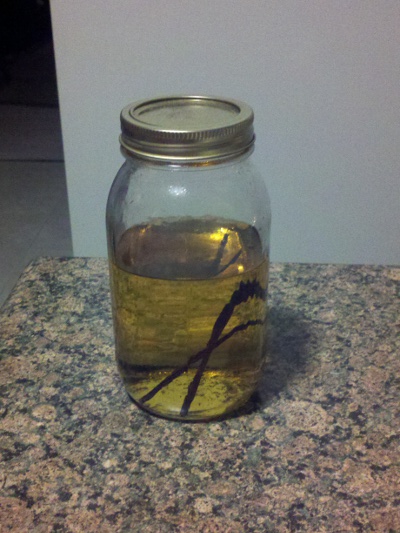
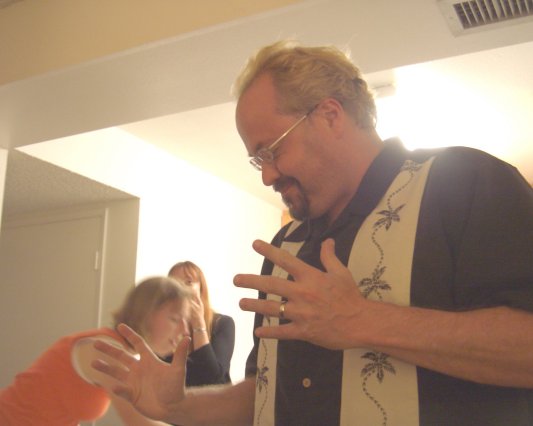
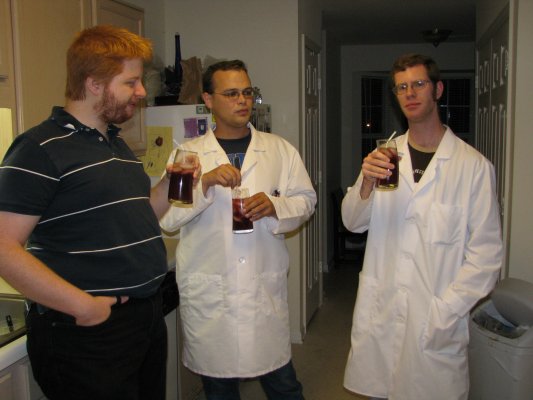
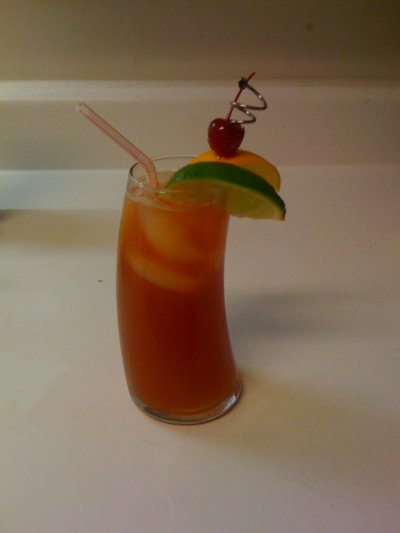
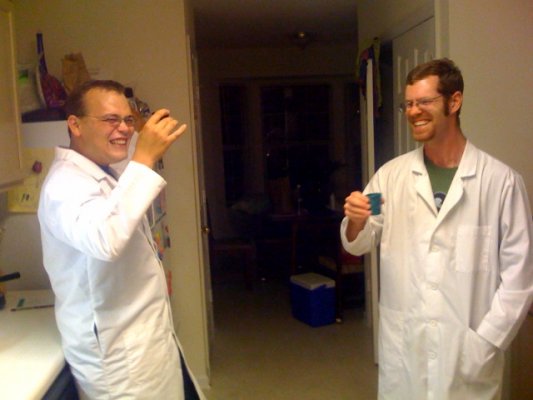
The other day, he sent us a few photos as a sneak preview to his review. The pictures resulted from a ten-dollar bet, in which someone challenged the Ferrett to drink a cup of our garlic, habanero, and black tea & lemon vodka infusions, mixed together. Never one to turn down an easy ten bucks, or even an excruciatingly horrifying ten bucks, Ferrett accepted the challenge.


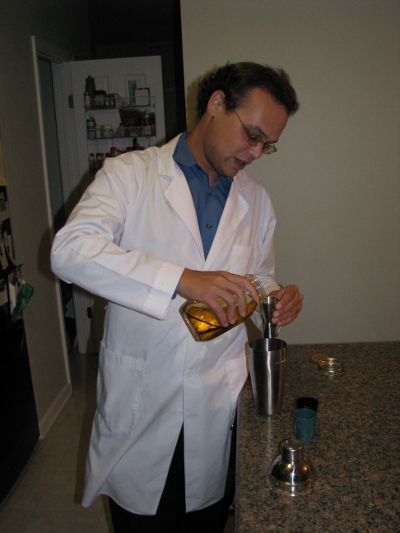
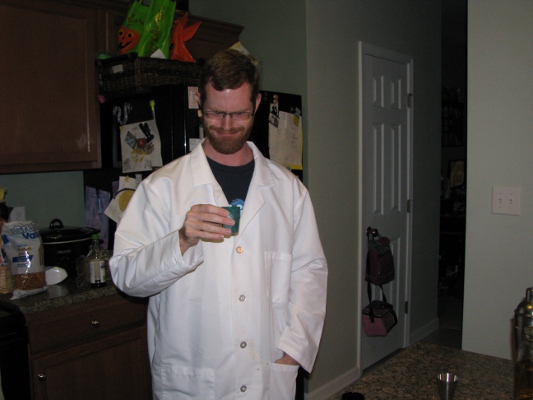
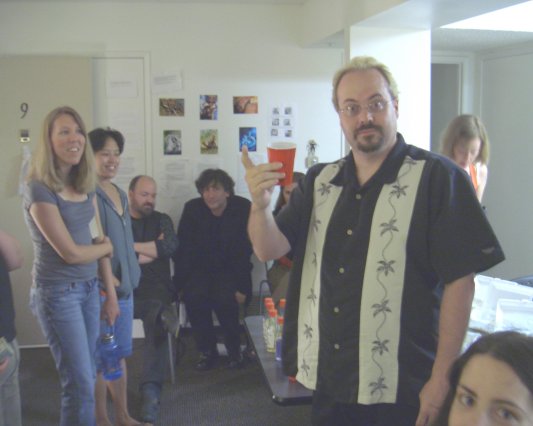
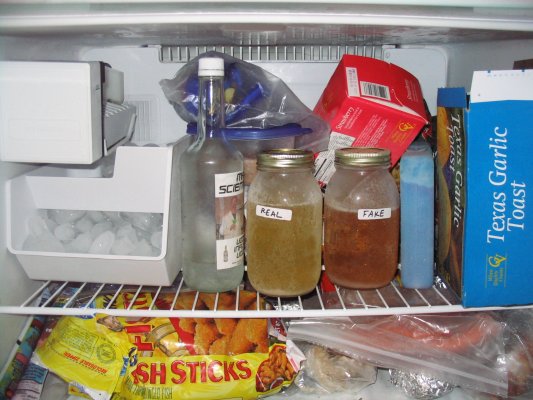
Here, the Ferrett steels himself for the task. His eyes boggle at this turn of events, but the rest of his face says nothing but determination. (Eagle-eyed viewers may spot Neil Gaiman, who is one of Ferrett's Clarion instructors, in center background.)


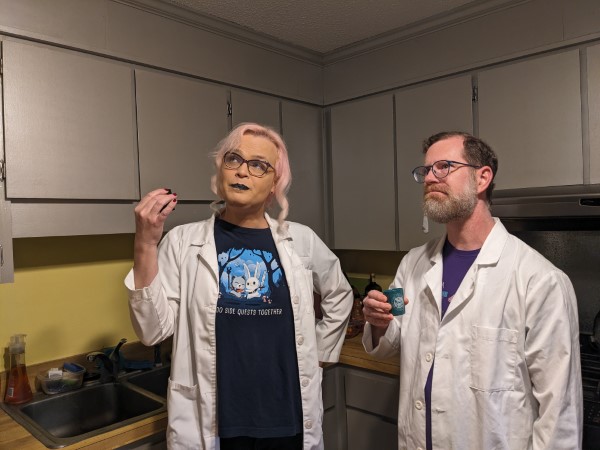
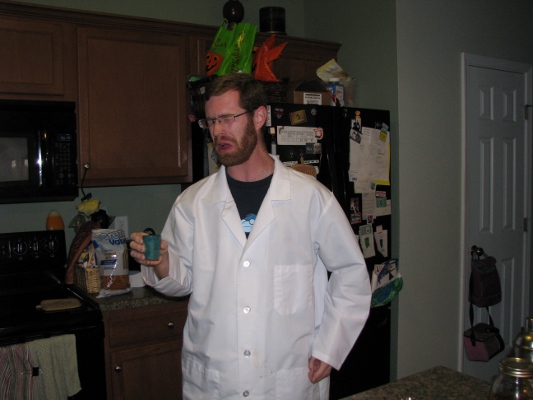
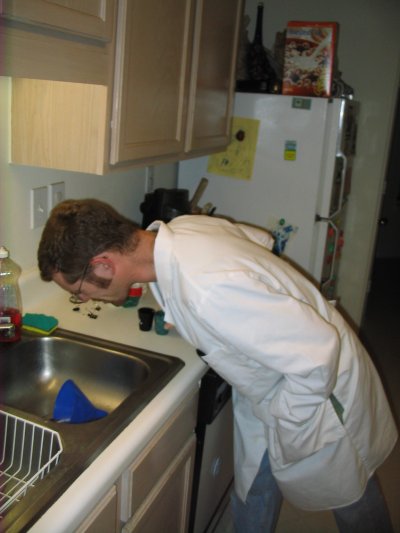
Ferrett sniffs at the cocktail of doom. What could be running through his mind at this moment?


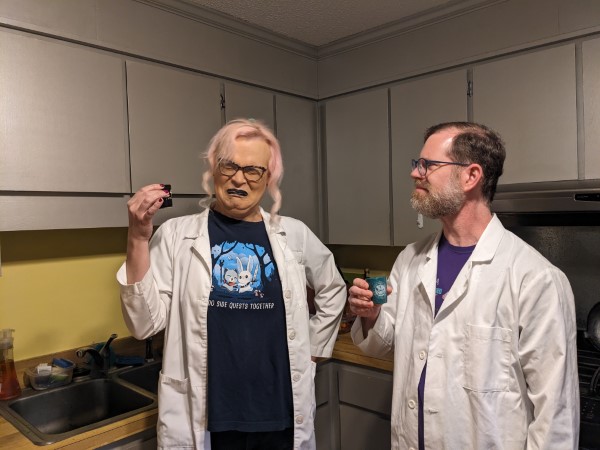
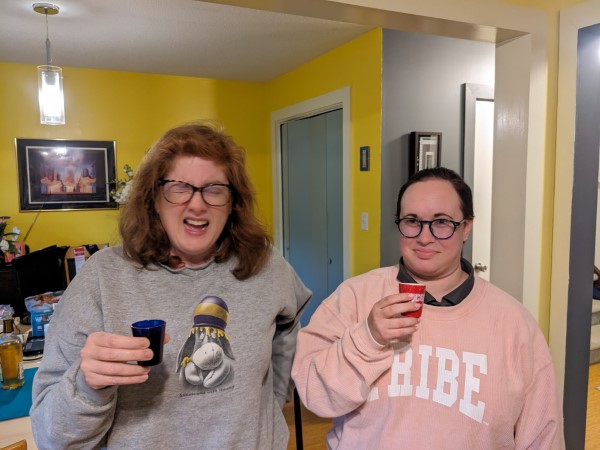
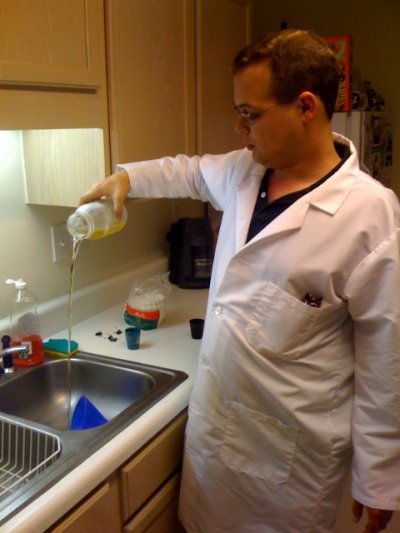
Without further ado, he knocks it back.


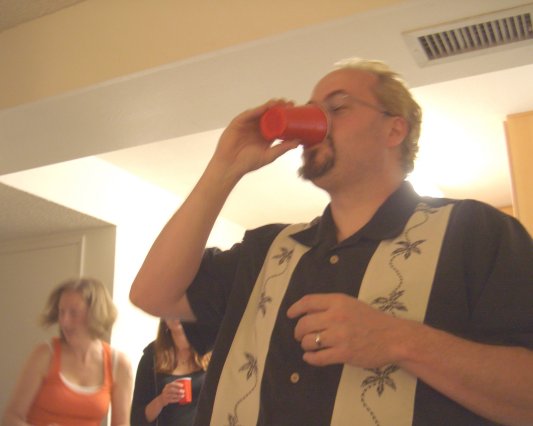
At first, he reels at the sensation as the mixture rolls down his esophagus...


...Then shock sets in as the sensation spreads through his body to his extremities. The shakiness of this photograph reflects the turbulence of his very soul at this moment.


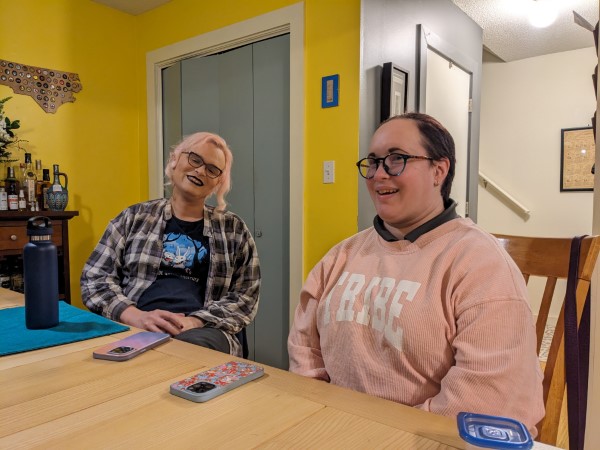
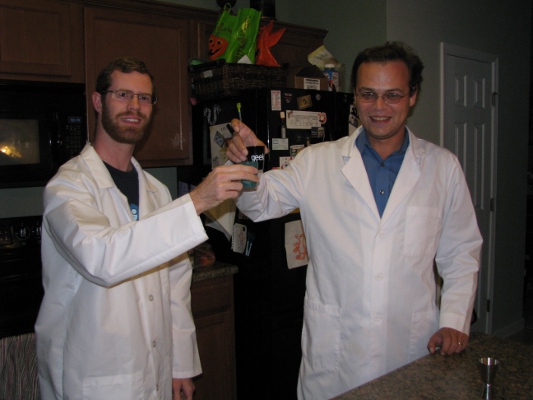
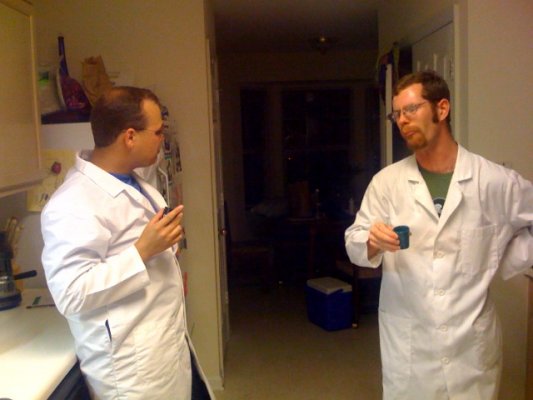
Shortly enough, however, Ferrett recovers his faculties enough to claim the spoils of triumph. Huzzah!


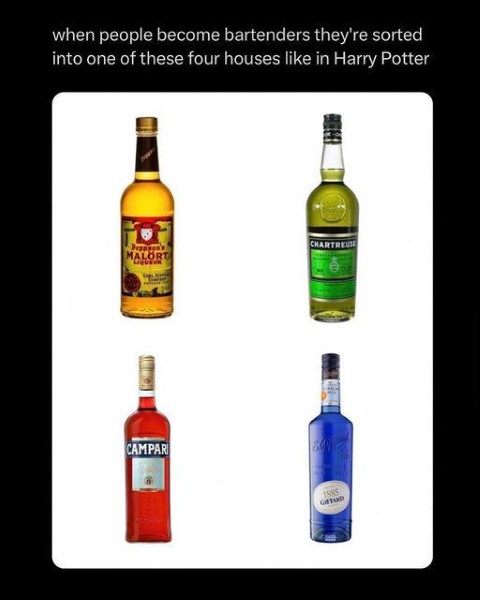
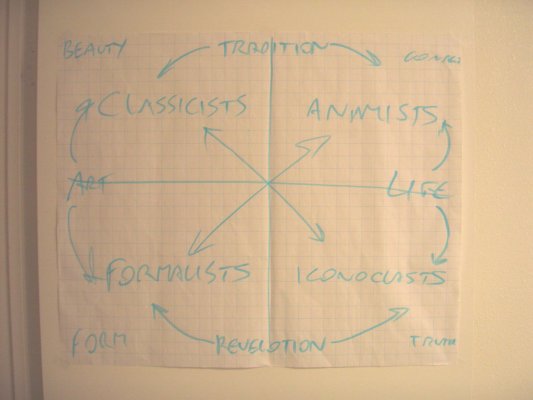
Ferrett also included a photograph which is unrelated to all of this; in fact, we're not sure if he included it intentionally at all. But it's damn cool, so here it is: a chart drawn up by Scott McCloud, classifying artists on a four-directional spectrum. You can read a more detailed description at Ferrett's post about the run-in.

Monday, August 11, 2008

North Cackalacky Sangria

It's Mixology Monday time again (yes, already!) and today's topic is Local Flavor. After deciding that revisiting our Cherry Bounce MxMo would be a cop-out, we wracked our brains trying to decide what we could write about that would qualify. Living in the Raleigh, North Carolina area, the folks around us seem to mostly drink cheap beer and chain-restaurant margaritas. Eventually, however, it occurred to us that the North Carolina wine scene has been expanding a great deal in recent years. Of course, a wine tasting isn't really what MxMo is all about, and we don't have the know-how for such a thing anyway. So we decided to take it in a direction that's a better fit and even kinda resembles our core competency (ha!), infusions. We resolved to pick up some North Carolina wine and make a batch of sangria.

That wasn't enough, though. We also swung by the local Farmer's Market to get some fresh, local (and even in season) fruits to throw in. We perused the offerings and settled on some peaches and blackberries. We also picked up some more traditional ingredients, a couple oranges and a lemon, at a grocery store; sadly, NC isn't a big citrus-producing state.

Now, the two of us are knowledgeable about many things. However, wine is not one of those things. So when we went looking for a North Carolina wine, we made our decision not based on anything we knew about the style, quality or producer of the wine (for we knew none of these things). Rather, we chose Duplin Winery's Black River Red because it was one of the first North Carolina wines we saw, and was labeled with a picture of Cape Hatteras Lighthouse, one of our state's most famous landmarks.

When we got home, we tasted the wine in its original state and found it to be a bit sweet. Scratch that. It was the sweetest wine either of us had ever tasted. I don't think I have tasted something so intensely sweet since high school, when I endured the dreaded Pixy Stix Torture at the hands of a girl I had a crush on. Don't get me wrong, on the occasion that I drink wine, I like something a little bit sweet, but this stuff is crossing a line.

A few days after the experiment (this afternoon, to be precise), I noticed that Raleigh's Independent Weekly was coincidentally running an article on the growing NC wine industry, spotlighting a number of talented and industrious winemakers but soundly panning Duplin Winery, along with other winemakers that use locally abundant muscadine grapes. I can see why the stuff would catch on here in the south, where we like our tea the same way (if it's too sweet, just add some lemon). Perhaps we could have found a finer example to represent our state, but time constraints limited our research. (In full honesty, we planned this entire experiment in about ten minutes this past Saturday, while also keeping an eye on Wayland's kids at a playground and poking at the internet on his iPhone for quick references.) However, we still had high hopes for the end result; sangria is meant to be fairly sweet, after all.


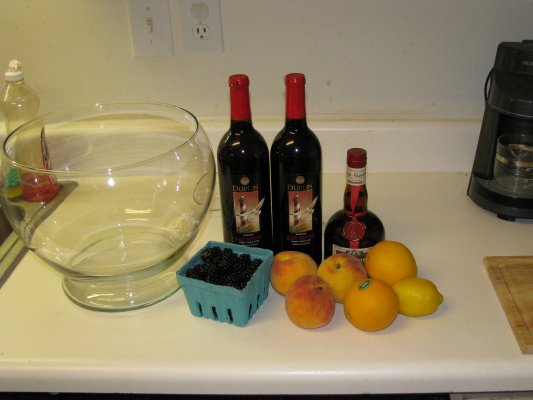
We made the sangria by combining the following ingredients in a punch bowl:

2.5 bottles Duplin Black River Red wine (about 1.875 L)
375 mL Grand Marnier orange liqueur
3 peaches, sliced into wedges
2 oranges, quartered
1 lemon, quartered
1 basket of blackberries, muddled (exact amount unknown)

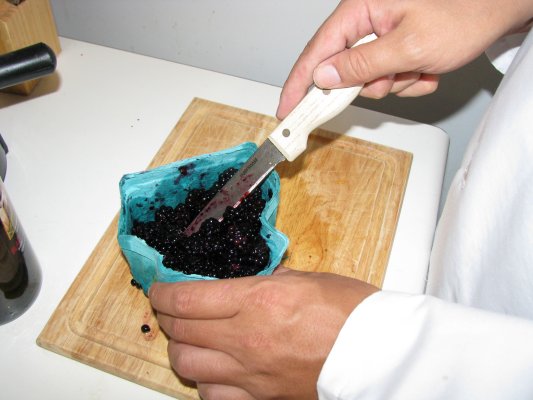
The blackberries presented a problem. We knew from our blueberry infused vodka that whole berries would not impart much, if any, flavor into the liquid. However, we were wary of squishing the berries, since we would be serving the drink from the punchbowl without straining it. We decided to break up the berries with a few carefree knife strokes, and later deal with whatever consequences we induced. As usual.


Since sangria is a drink to be shared with friends, we invited our buddy Jason over to once again participate in the tasting. (Little did he know what else we had in store for him, but that's a later post.) The ingredients were allowed to soak and mingle for three hours before serving over ice cubes.

The concoction was still quite sweet, but it wasn't the shocking sweetness of the wine itself. Though Grand Marnier is fairly sweet stuff also, the underlying flavors combined well and took the forefront. The flavors of the fruit pieces were difficult to single out, and we're not entirely sure if they combined just as seamlessly as the liquids or if they simply didn't have enough time to add much. I'd like to try this again with enough time to let it sit overnight. Inevitably, some bits of blackberry got into the glasses, but it was easy enough to work around them with straws.


We declared this experiment a success. It's not something we can afford to make regularly, but we bottled up the leftovers for future consumption, and will undoubtedly come up with an occasion to make it again and play with the recipe.


As a special bonus for our readers, we present an audio recording of this experiment's tasting. We recently acquired a nifty voice recorder to supplement our notes, and this was our first use of it. We probably won't post most of our logs this way, but we figured we'd try it a couple of times and see what people think.

Listen to the recording now (260 KB, .wav)

Transcript:

Wayland: Well, it goes down really smooth. ...I wonder how sensitive this thing is, if I can just talk and it catches it.

Brendan: I think it can.

Wayland: All right. It goes down really smooth; it tastes a lot like the original wine though.

Brendan: It's not quite as sweet as the original wine was. It's definitely got - you can taste that there's more alcohol in it.

Jason: What else is in here, other than wine?

Brendan: Grand Marnier, and fruit. Is there anything else?

Wayland: No.

Brendan: That's it, yeah.

Wayland: Yeah, a full bottle, well, a full 375 of Grand Marnier.

Brendan: For two -

Wayland: Two bottles of wine, yeah.

Banno (Brendan's cat): Meow.

Brendan: Meow.

Banno: Meow.

Wayland: I keep getting little chunks of blackberry.

Brendan: Yeah, it keeps getting - it's like drinking a Cook Out milkshake, you keep getting the straw clogged.

Wayland: Allrighty. There's our notes.

Jason: A bit fruity. Kind of like the people who make it.

Wayland: We're not fruity, we're nutty.

Monday, July 28, 2008

Pulling a Morgenthaler...

So, I started perusing the liquor cabinet, when I came upon some inspiration. Grape soda and Pop Rocks vodka. With even more artifical flavors than our legendary Red Dye #3 cocktail, how could I miss?
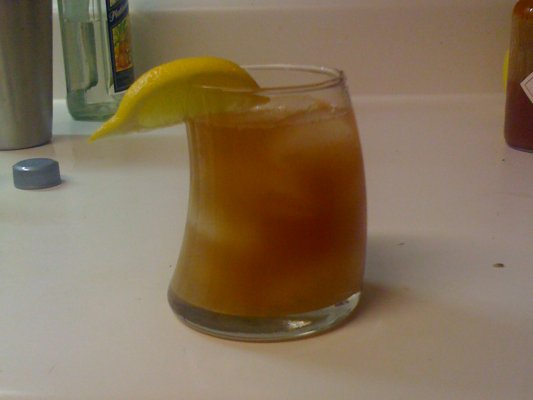
Well, miss I did. Surprisingly, it was very chemical tasting.

So, with the theory, in for a penny, in for a pound, I strove onward with the artificial flavoring and added about two ounces of Red Bull.

Unfortunately, this still wasn't right.

So, I added a spash of grenadine. Eh, this was better, but still tasted funny.

To keep with the theme, I added some Bright & Early orange breakfast drink, in stock due to a recent urge to return to my drinking roots. This made it drinkable. I decided to settle with this, rather than keep tweaking, because I knew I could drink it and didn't want to waste the alcohol.

As I sat outside, sipping on it, inspiration struck me. I put down my cigarette, ran back into the laboratory and said, "I'm pulling a Jeffrey Morgenthaler!"

Brendan and my lab assistant looked at me inquisitively.

"I'm adding bitters!"

They rolled their eyes.

I added a few dashes of bitters. And the drink became pretty damn good.

I let them both taste.

Lab assistant: "Wow, I would drink that! That finally gave it some body."

Brendan: "That's wierd! It actually worked."

Thank you Jeff, when a drink seems like it might suck, I will have to remember to add bitters!

Sunday, July 27, 2008

New Orleans MxMo

The Big Easy.

Crescent City.

The Birthplace of Jazz.

Paris of the South.

NOLA.

New Orleans is a city of many names, many cultures, and unique cooking. A place where folks flock to to celebrate Mardi Gras, a huge party well renown for drinking.

Unlike many of our fellow drink bloggers, we scienticians didn't make it to Tales of the Cocktail. So in order to participate in this month's Mixology Monday, we had to bring the tastes of New Orleans to our own humble lab. I scoured the net for something that felt sufficiently New Orleansy. Finally, I decided on the Creole, with a recipe found on Drink of the Week.

For those who didn't follow the link, the directions are as follows:

Creole

2.0 oz. Meyers's Platinum White Rum
1.0 oz. lemon juice
0.5 oz. Beef Bouillon
dash of Tabasco sauce
dash of Worcestershire sauce
dash of salt
dash of black pepper
lemon slice

In a shaker filled with ice, add the rum, beef bouillon, Tabasco, Worcestershire, lemon juice, salt and pepper and shake well. Strain into a highball glass filled with ice and garnish with the slice of lemon.

When looking at this recipe, the beef bouillon made us a bit wary, but we decided to press on in the name of science. However, we decided we ought to add our own twist as well, so after making a recipe to spec and then we would make it substituting the bouillon for our new bacon infused vodka.

So, onward to the original Creole.


My impressions: "I'm impressed, this came out nowhere near as bad as I feared. But my, how it burns; though, what else would you expect with a name like Creole. I'm still sweating as I write these notes. Now, onto the taste, it's very citrus-y, the burn doesn't seem to creep up on you until after you have finished your sip. But it leaves your lips tingling and, for me a self-professed capsaicin freak, a bit of a burning of the stomach lining."

Brendan's impressions: "This was definitely an odd taste sensation. It had a spiciness that was quite nice, but the flavor juxtaposition of citrus, Worcestershire and rum was very unsettling. Tasting this drink is like noticing a glitch in the Matrix: you can't quite put your finger on it, but you know something is not right in the world. It's not bad, exactly; just unpleasant."

Brendan's rating: 1.5 flasks out of 5
Wayland's rating: 2.5 flasks out of 5
Overall rating:


Creole: Now with Bacon!

2.0 oz. Meyers's Platinum White Rum
1.0 oz. lemon juice
0.5 oz. Mad Scientician™ Bacon Infused Vodka
dash of Tabasco sauce
dash of Worcestershire sauce
dash of salt
dash of black pepper
lemon slice

This was prepared the same way as the regular Creole.

My impressions: "I didn't really notice a difference here. I don't know how it would be without the beef or bacon, but in this drink, there doesn't seem to be much difference. This one only seems to burn a little less, but I don't know whether to attribute that to the change of meat or to the varying measurements of a 'dash.'"

Brendan's impressions: "I now know that when I tasted the original Creole, I had only begun to feel as if I couldn't put my finger on something. In terms of flavor, I couldn't tell you precisely what the difference is. In both the beef and bacon varieties, these flavors are fairly well masked by the other flavors. But there was something beneath the surface that made this drink more unpleasant than the first."

Brendan's rating: 1.0 flasks out of 5
Wayland's rating: 2.5 flasks out of 5
Overall rating:


After both these varieties, we couldn't write a post about New Orleans without actually finishing a drink. So we moved on from the Creole to the Hurricane.

I guess I should be a good bartender and share some trivia about Hurricanes:

Of course, the closest Major League sports team to my home is the Carolina Hurricanes.

I myself have slept through a hurricane, Hurricane Fran; I awoke the next morning, wondering why my music wasn't playing. Apparently, my entire family spent the whole night awake in the living room scared. We were lucky, though; the only thing we lost was power for a week.

During another hurricane that came through the area, as a restaurant bartender, I walked in the door and asked my manager what our drink special of the day was. He said, "How about we run $2.00 Hurricanes?" Less than an hour later, the power went out and I hadn't sold one.

Finally, the day Hurricane Katrina hit, my manager at a different restaurant had the audacity to run Tilapia Pontchartrain. For those that don't know, Lake Pontchartrain was the lake that flooded into New Orleans.

Which brings us full circle back to New Orleans, so after much searching, we decided to use this recipe to make Hurricanes:

2.0 oz. Meyers's Platinum White rum
2.0 oz. Goslings Black Seal rum
2.0 oz. passion fruit juice
1.0 oz. orange juice
0.5 oz. lime juice
0.5 oz. simple syrup
0.5 oz. grenadine


Now, in my early bartender days, I was thrown behind a bar and told, "You're a bartender now!" Some of the drinks I would look up, but anything fruity like a Hurricane or a Mai Tai, I'd throw some juices together with some rum to create something tasty and sweet, and no one really noticed. I've come a long way since those days, but in my searches to make hurricanes, I noticed there were 50 billion variations on this "common drink."

But when making this recipe, this is what I noticed. This is nowhere near as sweet as I expected. In my old days, they come out sweet and fruity and the guest was happy. This is a lot more tart than I would expect, but I'm not finding that to be a bad thing. The tartness in contrast to the sweet of the rum, truly brings out the rums' flavors. I'm kinda curious how this would have turned out with a spiced rum also.

Anyway, by the time we had a hurricane for each of us, it was well into the early hours of the morning, and Brendan and myself, in "Big Easy" fashion, spent the rest of the evening on the back porch of the laboratory, sipping our hurricanes and talking, until I finally stumbled off to sleep.

Brendan's rating: 3.5 flasks out of 5
Wayland's rating: 3.5 flasks out of 5
Overall rating:

Wednesday, July 23, 2008

Iiiit's Bacon!

It is finally time to revisit our attempt at creating a bacon infused vodka. This experiment, perhaps the most disturbing bacon concoction since the Vodka God's Super Pork Bacon Bomb, is in fact twofold; in order to increase our odds of discovering the perfect bacon infusion method, we are peer-reviewing a method found on the blog Brownie Points, as well as a method of our own devising.

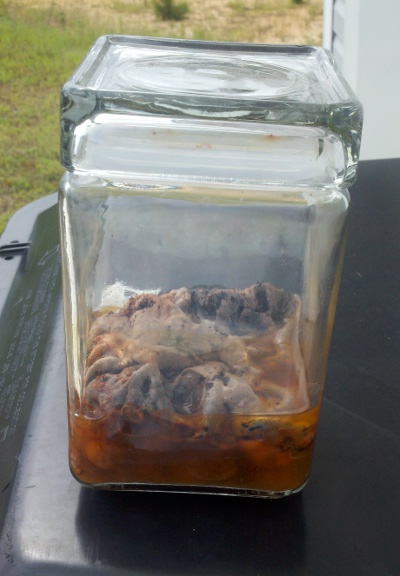
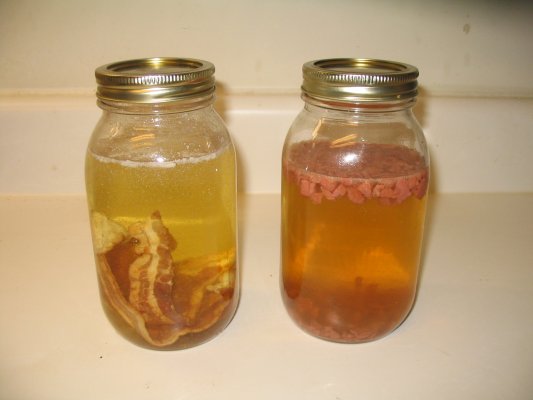
The Brownie Points method, as described in our previous post on the topic, begins as a straightforward vodka infusion, with a two-stage filtration process to remove the excess fat tissue. We infused a fifth of vodka with three bacon slices, storing it in a science cupboard for three weeks. The second batch, intended to avoid entirely the greasiness that has ruined other bacon vodka experiments we've learned about, was created using artificial bacon bits. After the three weeks were over, the two vodkae looked like this:


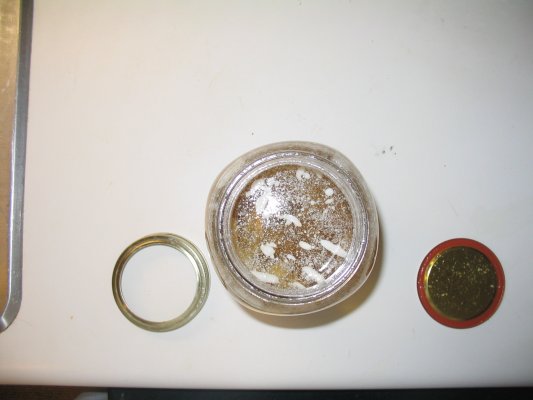
Here is an overhead view of the real-bacon infusion, to show just how much fat had to be filtered out.


We began by straining both batches of vodka through cheesecloth into clean science jars. We then placed the jars into the freezer, which theoretically would solidify much of the remaining fats, allowing us to perform the second filtration stage.

After several days in the freezer, both jars had a visible layer of sediment at the bottom.


We strained each vodka again, this time using a coffee filter. As we have encountered before, the cold vodka flowed very slowly through the filter. Rather than hold it in place for long periods of time, we attached the coffee filter to the funnel using a few binder clips around the edges.


At this point, it was time to taste the vodka. We decided, for better or for worse, to taste the fake bacon infusion first. I took the first sample, and quickly spat it into the sink.


Though we usually avoid using artificial ingredients in our infusions, we had hoped that using artificial bacon might eliminate the residue that real bacon leaves, particularly in the Vodka God's attempt. However, I can only describe the results as an atrocity. From the very instant this substance made contact with my lips, I was overcome by revulsion. I was only able to process the very front end of this taste sensation, and had already spat it out before it really registered. If you can imagine extracting the almost-but-not-quite flavor of artificial bacon bits into a liquid form and drinking it straight up, with an uncut alcohol kick for good measure, you might imagine what this was like. Which is exactly what it was, brainiacs that we are. All in all, it was quite possibly the most horrifying experience I have been exposed to in the making of this blog.

As if reacting to what it was witnessing, my long-serving Powershot A70 camera chose this moment to drop stone dead. As a result, the rest of the photos (and probably for the next few posts, at least) were taken using Wayland's iPhone, so please excuse the lower image quality.

In spite of my reaction, Wayland dutifully drank his sample in the name of science. The second portion quickly rejoined the first.


"Ugh. That's salty and disgusting," Wayland wrote. "I don't think I'll ever burn that off of my taste buds as long as I live. The thing is, it does taste a lot like bacon bits. But without the crunch, you realize just how bad imitation bacon bits are. Without the crunch, they are horrible pieces of evil destined to destroy your taste buds."

It is interesting to note that while I have reacted poorly to several of our infusions, this is the first time that Wayland has ever had a spit-take with our infusions. He may not always like them, but he always at least gets them down. It seems that the man who once drank bottles of Cisco in college (and woke up fresh the next morning) has finally met his match.

In accordance with several international laws, we opted to rid the world of yet another potential weapon of mass destruction, and poured this vodka down the sink.


At this point, it was quite late, so we decided to postpone tasting the real bacon infusion for another night. The next morning, however, Wayland skipped town, putting thousands of miles between himself and this experiment, and did not return for a week. He claimed that he was on vacation, and had planned it months before. I knew the truth, though. It took the entire week just to clear that taste off of the palate.

Eventually, however, we knew we had to finish the evaluation. We had much higher hopes for the Brownie Points batch; after all, it had been tried before, apparently with decent results.

We poured two samples, raised our science glasses and... drank!


As we had hoped with all of our might, this batch was much better than the other. "It's a little rough on the front end," wrote Wayland, "but that's definitely bacon. It's salty, but not overwhelmingly bad-salty like the artificial bacon bits. I think it captures the bacon flavor quite well, although I admit it is a bit unsettling to drink bacon."

I believe I spoiled the test by taking the full shot Wayland handed me. (We normally do half shots for experimental sampling.) It was difficult to get down at first, but once I began to process the taste, I found it to be a fair representation of bacon. Indeed, there were instants where I found it quite tasty. This is certainly a vodka to be sipped in small doses, but I think it is quite successful.

So, there you have it. Sorry it took so long, Katherine! We're ready whenever you are.

Monday, July 14, 2008

In that case, what's a "Gotham City?"

Cucumber is an idea which has come up a number of times when Wayland and I have discussed possible vodka infusions, and several of our readers have also mentioned it in comments and e-mails. For a long time, however, we put the thought on the back burner, thinking that the mild flavor of cucumber may not come through as easily as many of our other vodka flavors.

Eventually, we discovered a cocktail which made us rethink the role of cucumber, as it pertains to vodka: the Metropolis, courtesy of Svedka Vodka. (Warning: this website involves sound, and is also annoying in myriad other ways. The drink we're referring to is the first to appear under "future cocktails.") We were intrigued by this unusual-sounding drink, which involves muddled cucumber slices, vodka, sour mix and a splash of vanilla vodka, and determined to try it out. It was, in fact, very refreshing and tasty; we wondered if it could be improved by an actual cucumber infused vodka, and what other creations such a vodka could inspire.

Wayland began the experiment by slicing a cucumber, then cutting each slice into quarters to increase its surface area. We then cut off the skin, to prevent bitterness.


We sliced away the skin using a straight cut from corner to corner, resulting in small, triangular wedges. This was a time efficient method, though as my calculations determined, we discarded more than a third of the cucumber this way:


Sadly, this is not the first time we have used algebra and alcohol in conjunction.

Since cucumber is, as we said, a fairly mild flavor, we're estimating that this infusion will take at least three weeks. We will update with its status after the first tasting. Meanwhile, stay tuned for the results of our notorious bacon infused vodka, coming later this week.

Wednesday, June 18, 2008

Bacon vs. Fake Bacon: Grudge Match!

The very first comment we received on our first post at Infusions of Grandeur was a request. That request has become both a running joke and a Holy Grail in the laboratory, something we've always wanted to do but never dared. The request was for vodka infused with the flavor of bacon.

Not long after we launched the site, a bacon vodka was in fact attempted by one of our mentors, the Vodka God. Unfortunately, his bacon infusion was roundly regarded as a failure, retaining an unpleasant fatty residue even after filtration. After the Vodka God's bust, bacon vodka was set the more firmly in our minds as a bad idea, though we occasionally considered trying it with artificial "bacon pieces" such as Bac-O's. (The Vodka God used pre-crumbled, reduced-fat bacon bits, but they were made of genuine bacon.) Last week, however, my esteemed colleague discovered a January post on the blog Brownie Points, which described another methodology for infusing vodka with real bacon and removing the fat afterwards.

We decided to peer-review the Brownie Points method, and to simultaneously create a fake "bacon" bits infusion for side-by-side comparison.


Part One: Brownie Points method

Brownie Points' author McAuliflower developed her bacon vodka by infusing vodka with cooked strips of bacon, unrefrigerated for three weeks. She then placed the infused vodka in the freezer, allowing the fats to solidify, then strained out the frozen fats using a coffee filter. (The Vodka God also kept his vodka in the freezer for serving purposes, but his vodka was only filtered pre-freezing, if we are not mistaken.) Of course, due to the chemical properties of ethyl alcohol, the vodka itself will not actually reach the freezing point in most household freezers.

Wayland began the experiment by frying some bacon in a science pan. We used three strips of bacon for the infusion; a fourth was reserved for immediate consumption.


The bacon was cooked until crisp, and laid on paper towels to drain off as much grease as possible. We then sealed the bacon in a science jar with 750 mL of vodka, and placed it in a dark cupboard.


Part Two: Artificial bacon bits method

For the second test batch, we used 1/2 of a cup of McCormick Bac'n Pieces. As we discovered, dogs really don't know it's not bacon.


The bacon bits contain no cholesterol, but they do have 1.5 grams of fat per 7 gram serving. This means that they are roughly 21% fat, so our attempt to eliminate fatty residue may well backfire on us. For the record, the ingredients listed on the bacon bits' label are as follows: textured soy flour, partially hydrogenated soybean oil, salt, corn starch, natural and artificial flavors, caramel color, hydrolyzed soy protein, corn gluten, wheat protein, FD&C red 3, and autolyzed yeast.

We combined half a cup of bacon bits with 750 mL of vodka and shelved it. For control purposes, we will subject this batch to the same freezing process as the other one.

We'll see how this turns out in three weeks!